Showing posts with label Roland Barthes. Show all posts

Tuesday, 5 April 2011

Night-time Photoshoot - Victoria Mills

The main (new) building and Walkway

The old building (over the Tennis Court)

The Fountain and Runway (Lighter Filter)

The Fountain and Runway (Darker Filter)
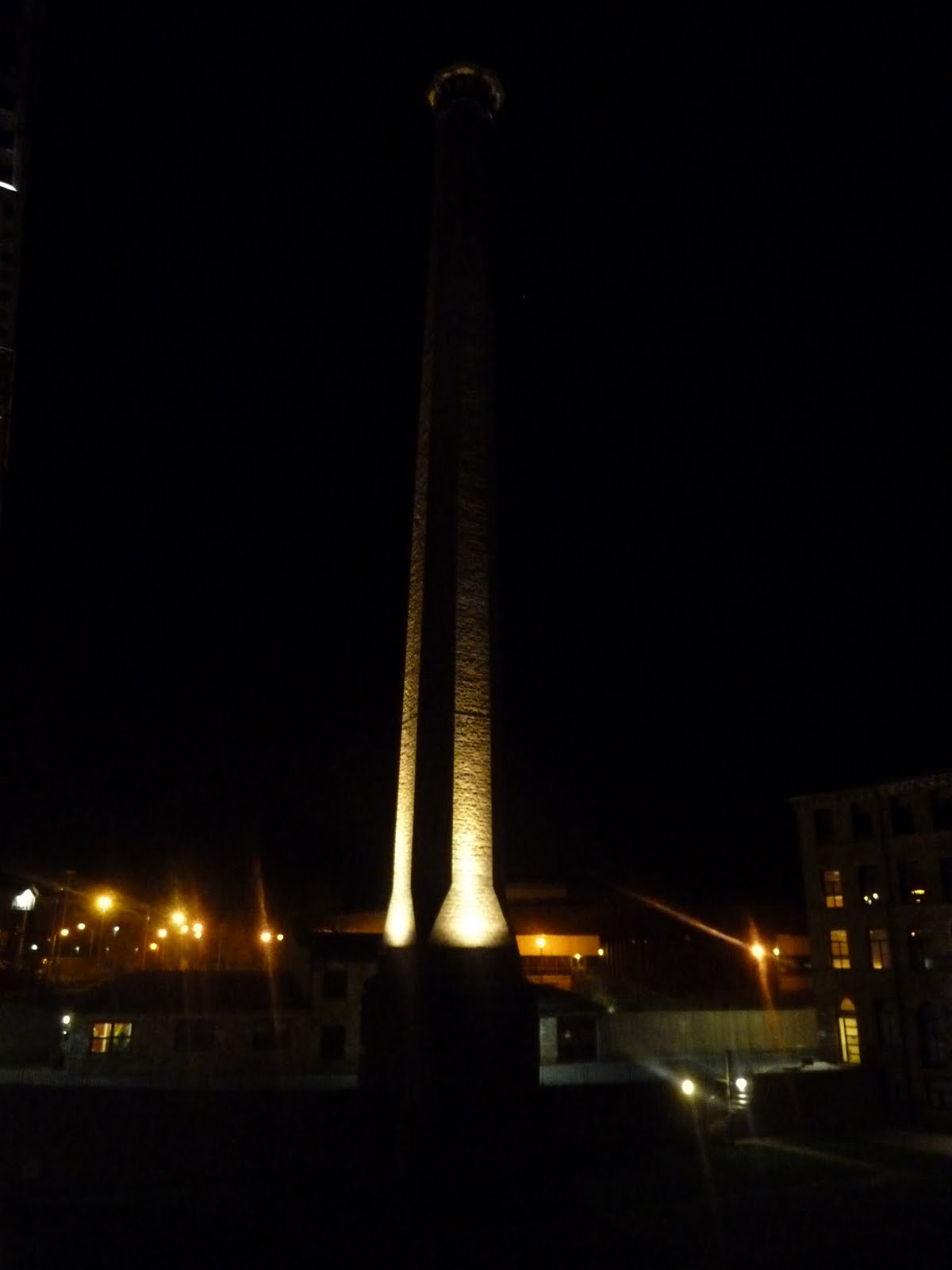
The Chimney

Yesterday, I was staying over at Victoria Mills, and was captivated by the sights of the chimney and the walkways all illuminated. I took a number of photographs, with the intention of manipulating the strangest one to suit the style of my Comic-book storyboard idea (see below).

The images above are all quite dark, but this was deliberate. I had a go at using different filters on the Camera to get different effects, but found that to tie in with previous entries about darkness, shadow and contrast, leaving the settings to compliment the hour of day worked really well.

The images require careful study to make clear sense of what they depict, due to the intense use of shadow. But by adding in captions beneath each image (Anchorage and Relay, Barthes), I can explain a little easier the key features shown.


The Chimney Base (Original)


The Chimney Base (My Manipulated Comic-Style)

Sunday, 27 March 2011

Decisions, Decisions....

Coldplay - Fix You

Keane - She Has No Time

Owl City - If My Heart Was a House / Vanilla Twilight

Snow Patrol - You Could Be Happy

You Me At Six - Fireworks / Liquid Confidence

All of these are (in my honest opinion) lyrically beautiful. They all also effectively tell a story, which is, I guess, the whole point of Visual Communication, when you get down to it. So to have a song where they lyrics are going to be supportive of any imagery added in (and here I'm thinking about Barthes' theories of Relay) will make the story that little bit simpler to understand in the long-run. They are also mostly fairly slow songs in terms of pace and tempo. This would be greatly beneficial to me with regards to how I could go about making the hypothetical video. For a fast-paced song, a lot more images would be required to coincide with the lyrics. But with fewer lyrics, I can use fewer images, thus subsequently making my job that little bit less complicated.

Considering time-scales, I'm still uncertain as to whether or not creating an actual video is going to work out. Perhaps I should start off by creating a storyboard to accompany my chosen song. Then, I can decide whether or not to make an increased version of that storyboard, or work on turning part of the song into a music video.

Either way, I will still be making the content in the same way as I had originally planned: photogaphy / moving image representative of individual lyrics to then be manipulated into a comic-book style using computer software. Mother Earth, help me. This is going to be the longest few weeks of my life.

Tuesday, 15 March 2011

Roland Barthes - Relay

Reference to:

Barthes, R. (1977) "Rhetoric of the Image." Image, Music, Text. Ed. and trans. Stephen Heath. New York: Hill and Wang. 32-51.

As a follow-up, here's the other side of the 'language and image' marriage:

"The function of relay is less common (at least as far as the fixed image is concerned); it can be seen particularly in cartoons and comic strips. Here text (most often a snatch of dialogue) and image stand in a complimentary relationship."

Take the image on the left as an example (I'm sorry, but it made me LOL so hard. Had to include it).

It is pretty obvious in the image what is happening, though without direction, some unusual persons could probably mis-read the image minus a caption (aka chavs).

To dumb it down for said unusual individuals, a 'macro' - or caption, in posh terms - has been added to compliment the image (or to demonstrate in lay-mans terms just exactly what is happening in the image).

For hilarity, rather than using 'proper English' to describe the content, text speak (or game speak) has been included. This makes the image immediately attractive to gamers, youngsters, geeks, (even chavs!), etc. I suppose it would probably not count as a relay example to those who do not understand the meaning behind the word represented (bless, it would probably just serve to confuse them). However, for those who do understand that 'powned' is a gamer term for being beaten quite violently by an opponent, the language directly compliments the image, thus relaying meaning between text and picture.

Before you ask, no I'm not going to include this in my essay... but it made me chuckle.

I doubt Barthes could ever have predicted his theories would one day be used to describe a Macro image...

Roland Barthes - Anchorage

Reference to:

Barthes, R. (1977) "Rhetoric of the Image." Image, Music, Text. Ed. and trans. Stephen Heath. New York: Hill and Wang. 32-51.

The concept of an image having endless interpretations without an attached caption to ground the viewer's rogue imaginations fascinates me.

Barthes believed, "... all images are polysemous; they imply, underlying their signifiers, a 'floating chain' of signifieds, the reader able to choose some and ignore others."

In a sense, he describes an image's ability to give off a great (sometimes limitless) amount of different interpretations, depending on social, ethical and stereotypical inclinations of the viewer in question, who can then choose for themselves what they believe to be the truest interpretation. What is depicted for one type of person will differ completely from what another person sees in the image; due to reasons like social status, personal upbringing, cultural reference and individual opinion. Without a caption to ground the image and describe / explain EXACTLY what is depicted, there is no way of saying for certain what the true purpose / description of the image really is.

Anchorage does this - adds a description or a caption to an image, giving the reader absolutely no doubt as to what the content actually displays. This way, the media artist can get across a specific meaning, one that will be virtually universally recognised for what it is. Without this 'anchor', the possibilities are endless.

People will believe what they want to believe until it is proven otherwise.

Take the image on the right as an example.

I could tell you that it's actually an image of my great uncle. And unless you'd seen the image before, there's absolutely no way to disprove my interpretation. (The fact that I did have a great uncle who looked rather like him is irrelevant).

Similarly, I could admit to you that it's actually a sketch-drawing of Roland Barthes, himself (if Wikipedia is to be believed...). But there's nothing to say I'm telling the truth (even though I am). Thus, demonstrating that Barthes' thesis does actually make sense: without an anchor, viewers are free to interpret the image in any way they choose.

Like I said. Fascinating.